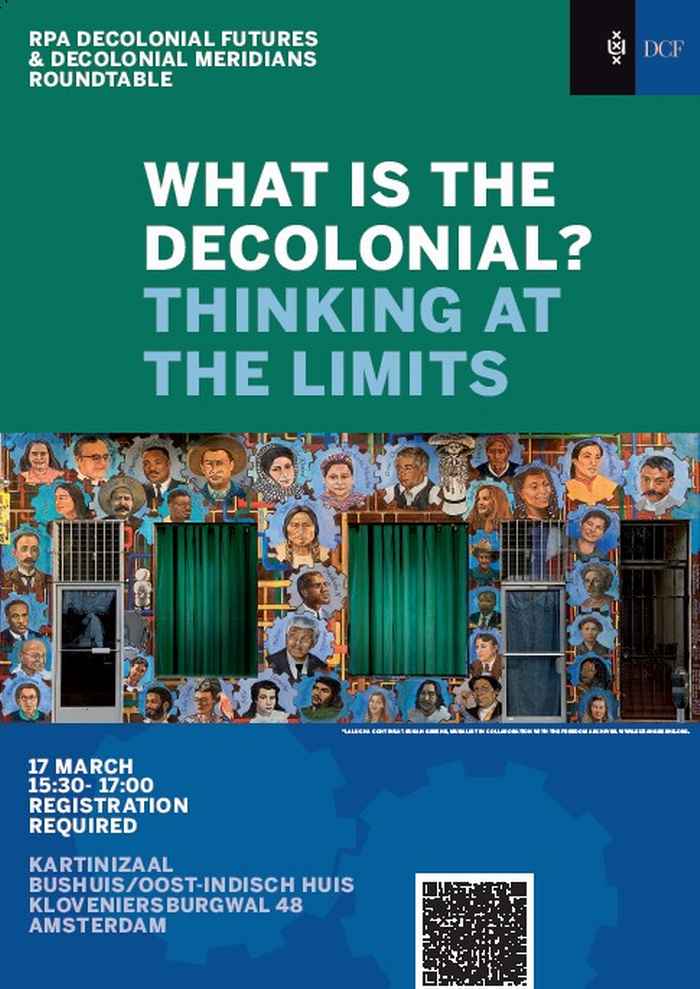
RPA Decolonial Futures & Decolonial Meridians Roundtable |"What is the Decolonial? Thinking at the Limits"
This event is now at capacity, please send an email to decolonialfutures@uva.nl to be added to the waiting list.
- Date
- 17 March 2026
- Time
- 15:30 -17:00
- Location
- Bushuis/Oost-Indisch Huis
- Room
- Kartinizaal
In 2026, the RPA 'Decolonial Futures’ is beginning its research and publication agenda. Having initiated the Seed Grants and Visiting Scholars program in its first two years, the following three years of the RPA will be streamlined further into initiating and building research lines that actively address the meanings, scopes, and most importantly methods of decolonial thinking and practice itself.
In this first roundtable, the coordinators and a newly formed Editorial Committee will introduce to the UvA community how we visualise the steps ahead, and have in conversation our colleagues from across the humanities faculty, who have been exploring such questions from various iterations and concerns. In this first roundtable, Sruti Bala (Editorial Committee member) and Sanjukta Sunderason (RPA coordinator) will be in conversation with
- Sudeep Dasgupta, Media Studies
- Alessandra Benedicty-Kokken, Literary and Cultural Analysis
- Nawal Mustafa, Cultural Studies
The core question at this roundtable is an open-ended and foundational one: What is the decolonial? We are actively invoking here the Marxist cultural theorist Stuart Hall’s generative critical engagement with the temporality and stakes of the ‘postcolonial’ 30 years back (Stuart Hall, “When was The Post-colonial?: Thinking at the Limit”, 1996) and bringing into that genealogy of anti/post colonial thinking the new– and ever-so proliferating vocabulary of the decolonial today. We will ask ourselves in this roundtable – what does the decolonial mean to our own disciplines/practices/thinking? What scopes and limits do we see in the idea?
Given the soaring ethical and normative purchase of the word – and the just corrective from Eve Tuck and K Wayne Yang that decolonization is ‘not a metaphor’ but indeed active struggles for land and sovereignty – how do we as scholars in the humanities approach those ground realities – and historical tensions – of the idea of the decolonial? For instance, is the decolonial about sovereign futures, speculative imaginaries, ethical politics, or a continued ‘duress’ of a wounded, fragmented colonial past? It can be all of these of course, but in our practices and pedagogies, this heterogeneity of the idea- and the very question of the decolonial method- need to be expanded upon in a generative way. In this roundtable, we are initiating a small step towards that.
To attend please RSVP here or send an email to decolonialfutures@uva.nl