Entangled Freedoms & RPA Decolonial Futures Roundtable| LIBERATIONS: Questions For Art And Theory
- Date
- 1 June 2026
- Time
- 15:30 -18:30
- Location
- Bushuis/Oost-Indisch Huis
- Room
- Kartinizaal
About the Roundtable (1 June)
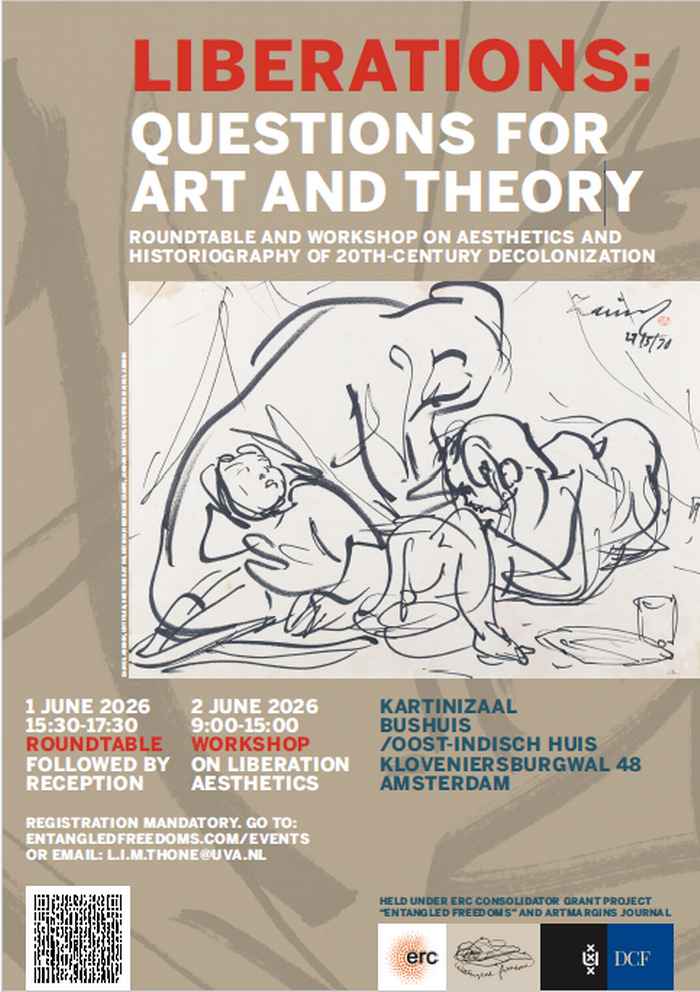
This roundtable is designed to put into conversation scholars who have for long engaged with practices and theories of art, postcolonial modernisms and cultural histories of decolonization, to reflect on a singular guiding question: What concerns are guiding histories of decolonization today – and what is revealed when we look via the vantage point of art? Our entry point of “Liberations” streamlines our attention to a unique modality of twentieth-century decolonization that exceeds nation-statist or realpolitik-driven narratives of postcolonial transfers of power. Liberations – as a decolonial modality – invokes multiple forms: anticolonial movements for political as much as cultural and economic sovereignty; visualizations of crises and equitable futures; or persisting questions of historical duress that keep the question of freedom alive despite postcolonial transitions. We find within the scope of “liberations” both the densities of the historical and the imaginations that reveal as well as transcend such historical experience. Art – as artistic form and practice, as well as archive for historical theorization – is central here. It aims to set out programmatically what questions the notion and practices of liberation pose for thinking art and theory; and how practices of both art and theory might destabilise and reframe what liberation might mean for decolonization.
As we foreground “Liberations” to draw questions for art and theory, we want to stress the importance of thinking via the histories of decolonization, rather than the more current and timely calls for “decolonizing” histories/institutions/epistemes. There are two core sets of reasons here that animate the historical here:
The first reason is around historical time itself: we want to foreground the dense, displaced, and persisting histories of twentieth-century decolonization that remain understudied or fragmented in the art/histories we write. A connected and somewhat obvious reason is that such histories shape our presents, as we can see today. This calls for practices of ‘recognition’ of the past as it flashes in moments of danger in our fraught presents – an argument famously made by Walter Benjamin right before he would claim his own life in the thick of the World War II in 1941. A return to the fissures of twentieth-century decolonization also allows us to apprehend the double-edged nature of current calls for liberation.
The second reason is one of historiographical memory: we have on the panel speakers who have worked widely with the art/archives from the decolonizing worlds of the twentieth-century. Today they are playing various roles – working on new book projects, steering archival initiatives, making new art, thinking new writing strategies. Standing within the density of our contemporary times, as we see echoes – of twentieth-century liberation movements, patterns of neo-imperial wars, cycles of displacement, and cultural resistance itself – reanimating what we see, think, and grapple with today, we want to ask our panellists to reflect on some historiographical questions emerging from their own practice:
How do they look back at questions that animated their early encounters with archives of art and twentieth-century decolonization? What are the new questions they are exploring today?
How do they conceptualize the question of liberation – and freedom itself – that sit at the core of twentieth-century decolonization – but were often overtaken by nation-statist narratives or indeed neo-liberal, right-wing agendas?
What connections are they making between histories of art and decolonization across what we now call the Global South (the Third World of the twentieth century)? In effect, are there possibilities here for a connected theorization of art and decolonization from the Global South?
Participants (in alphabetical order):
• Kate Cowcher, Art Historian, University of St. Andrews
• Elizabeth Harney, Art Historian, University of Toronto
• Zeina Maasri, Art Historian, University of Bristol
• Naeem Mohaiemen, Visual Artist, Researcher, Columbia University
• Sanjukta Sunderason, Art Historian, University of Amsterdam
Introduced and moderated by Lotte Hoek, Media Anthropologist, University of Edinburgh
Order of events:
15:30-15:45: Coffee and tea
15:45-17:30: Roundtable and Q&A: Liberations: Questions
for Art & Theor
17:30:1830: Reception
Registration via the link below or send an email to Lilli Thöne (l.i.m.thone@uva.nl).
The roundtable is being jointly sponsored by the ERC Consolidator Grant project, Entangled Freedoms and Research Priority Area: Decolonial Futures at the University of Amsterdam. Both share a commitment to thinking decolonization via its historical, conceptual, and methodological registers. In particular, this roundtable – conceptualised as part of the RPA’s new thoughts in progress publication portal – will be a historiography and methods-driven conversation on what questions – and art/writing forms – we draw from and via art as archives for thinking decolonial futures.
About the Workshop
Liberations: Questions for Art and Theory is being organised at the University of Amsterdam between 1-2 June 2026 as part of the ERC Consolidator Grant project – Entangled Freedoms: Decolonial Modernisms as Transnational Relations of Resistance, 1940s-1980s (2024-2029), steered by Dr. Sanjukta Sunderason, and as groundwork for a Special Issue on Liberation Aesthetics with the journal ARTMargins. The workshop and the Special Issue are conceptualised by Dr. Sanjukta Sunderason (University of Amsterdam) and Dr. Elizabeth Harney (University of Toronto), both editors at ARTMargins.
The event spans 1-2 June with various entry-points into these questions – roundtable, panels; exhibition visit; and film screening – supported by our partners, the Research Priority Area “Decolonial Futures”, de Appel Amsterdam, and the Eye Filmmuseum.
For more on the workshop and the full programme click here.
For more on Entangled Freedoms click here.