RPA Decolonial Futures Roundtable | Latin America in the Face of Relaunched Imperialism
- Date
- 30 June 2026
- Time
- 14:30 -18:00
- Location
- Bushuis/Oost-Indisch Huis
- Room
- Kartinizaal
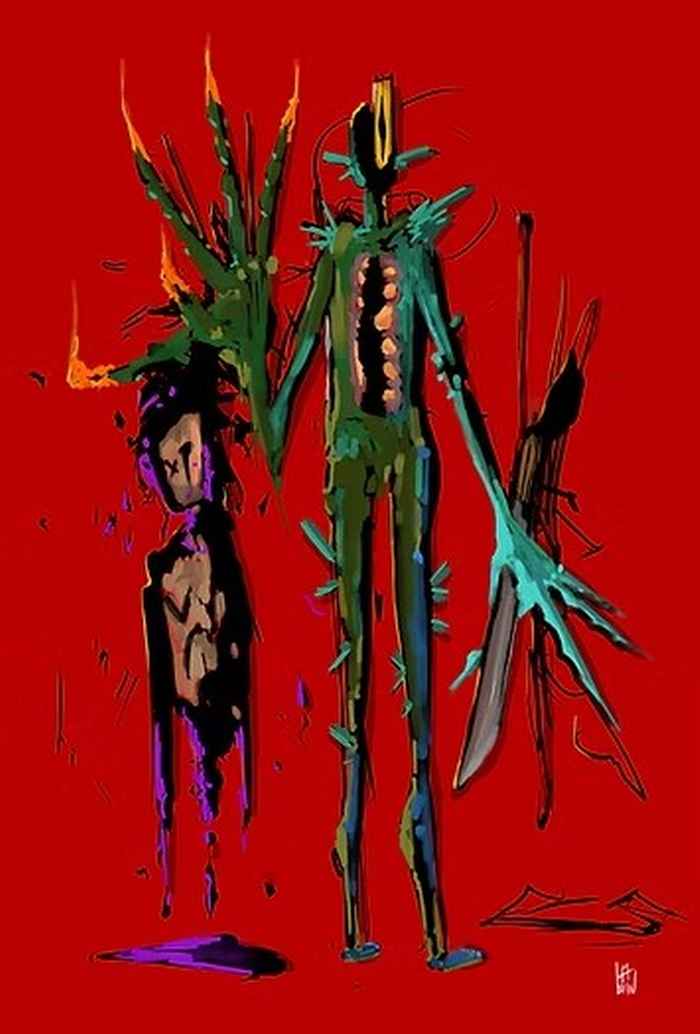
Drawing on experiences from Brazil, Chile, Colombia and Mexico, four Latin American scholars open up a conversation about art, performance and rituals at their intersections with activism and political resistance in times of renewed imperialist threats — as seen in the so-called Donroe doctrine launched by Washington across the ‘American’ hemisphere. The cases discussed include the organised indigenous movement fighting against the privatisation of Amazon rivers, performance practices unsettling neofascist myths, carnivalistic parodies of US interventions, and civil resistance against multinational energy projects threatening a marine sanctuary.
With the above as a common entry-point, this roundtable reflects on concrete experiences across Latin America to ask how they sustain a positioning that reveals (de)colonial tensions today and points towards possibilities of reconciling decolonial theory and its praxis. At a time when notions such as delinking, territory, sovereignty and revolution are increasingly being called upon under a new, urgent light, the conversation seeks to grapple with the risks of institutionalising decolonial discourse and the contradictions between progressive political imaginaries and enduring extractivist structures.
From Brazil, we look at the organised indigenous movement resisting internal and external imperialist forces through a recent occupation of Cargill’s port facilities in Santarém by 1200 activists representing 17 peoples. The 33-day encampment, which included artivism interventions, cultural and ritual practices, resulted in nationwide mobilisations and the successful revoking of a Presidential decree that had authorised the privatisation of waterways on Amazon rivers.
From Chile, we reflect on the afterlives of the Nazi myth within the dictatorship and its reverberations in the present, as (official) political discourses and imaginaries rehearse fantasies of purity, cleanliness, and social order. We turn to artistic and performative practices that unsettle these narratives and make visible the mythic machinery sustaining them.
From Colombia, we discuss how carnivalistic and musical mise-en-scenes challenge fabricated neo-imperial narratives. In parodying highly theatrical operations recently conducted by North American military forces in the region, performers challenge the violence and anti-progressive drive that such coups seek to normalise.
From Mexico, we look at the organised civil resistance against the Saguaro and AMIGO GNL projects. We turn to language performativity to uncover the Trump administration's framing, such as "beautifying coal" and befriending gas fracking. Furthermore, we will look into the social media strategy used to create awareness about the damaging effects of these projects on a World Heritage marine sanctuary, which also intends to add social pressure as legal actions are underway to stop these initiatives.
The roundtable discussions will be disseminated in the form of a jointly authored publication on the Decolonial Futures publication portal by the end of 2026. It also serves as a preview and public launch platform for ARRANCA Amsterdam - Encuentro Latinoamericano de Estudios y Acciones Escénicas, a festival and encounter currently in pre-production for the season 2026/2027. ARRANCA seeks to bring together Latin American scholars and artists based in the Netherlands for a week of roundtables, workgroups, laboratories and performances, open to the general audience.
The Roundtable & Q&A is followed by a reception from 17:00-18:00.
Latin America in the Face of Relaunched Imperialism is free to attend and welcoming of the broader academic community. Registration required via the link below or send an email to decolonialfutures@uva.nl.
About the Organisers & Speakers
Martina Flores Mendeville is a PhD candidate in Theatre and Performance Studies at the University of Amsterdam, affiliated with the Amsterdam School for Cultural Analysis (ASCA). She examines the intersection of materials, myth, and cannibalism in Latin American stagings of Heiner Müller. Her research engages with cosmologies, relational theories, and artistic practices.
Geraldine Lamadrid Guerrero is PhD candidate in Latin American Studies at the University of Amsterdam, affiliated with the Amsterdam School for Regional, Transnational and European Studies (ARTES) and the Center for Latin American Research and Documentation (CEDLA). Her work exists at the intersection of political theatre acting, socially explorative performances, and artistic practice-based research to investigate how exercising artistic freedom of expression can foster critical hope and social relief.
Juan Montoya-Alzate is a humanities senior lecturer at Erasmus University College (Rotterdam) and PhD from the Amsterdam School for Cultural Analysis (UvA). His research focuses on music and performance in Northern Colombia and the Caribbean. He has collaborated as journalist and news editor for several Colombian media outlets.
Samantha Pires Vianna is an independent researcher, cultural programmer and artist, with an MA in Theatre Studies from the University of Amsterdam. Her academic research sits at the intersections of culture, politics and social justice, and focuses on performance practices in sites of resistance and (un)freedom, with particular attention to the Brazilian context.
Moderator: Dr. Julienne Weegels, Assistant Professor Latin American Studies (CEDLA) & RPA Decolonial Futures Board Member