Seed Grant Spotlight #1: The IMI & RPA Decolonial Futures Winter Academy (Tijuana, México) draws to a close
3 February 2026
Last week, members of the IMI Winter Academy participated in a diverse programme that sought to challenge the logics of migration criminalisation and control, and to reimagine mobility and the futures of migration. Participants examined how borders and borderlands are lived, contested, and resisted under conditions of violence, control, and surveillance, drawing on the lived experiences of migrants, community leaders, and activists, as well as the insights of shelter managers, employees, and volunteers.
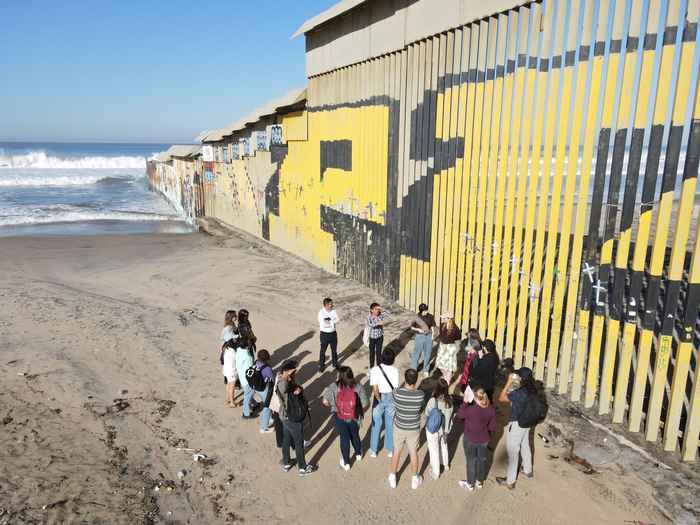
The Academy began with a visit to the Latin America Corner, where participants engaged with the border wall and heard from Estefanía C. (University of Southern California) at one of the main border crossing points. Her talk explored themes of power, temporality, and control, and examined how border communities experience crossing as part of their everyday lives. This was followed by a visit to Tijuana Airport to observe the Cross Border Express (CBX). The day concluded with a visit to the Instituto Nacional de Migración, where Mexican authorities shared their perspectives on border crossings, migration routes, and the various forms of state support available to migrants and returnees.
On Day 2, participants visited Embajadores de Jesús, one of the largest shelters in Tijuana, where they learned about the shelter’s history, reception processes, childcare provision, and educational services for internally displaced and stranded migrants. They also visited the Latina Muslim Foundation, where the shelter’s director shared insights into the experiences of Muslim migrants in Tijuana. In addition, participants met with Vivianne Petit, a community leader and activist within the Haitian community in Tijuana, and visited Casa de Luz, an LGBTQI+ inclusive shelter, where they learned about the resilience of the community and the ongoing challenges faced on this side of the border.
On Day 3, the Academy hosted a colloquium in collaboration with the IMI, the Universidad Iberoamericana Tijuana , El Colegio de la Frontera Norte, A.C. and UC San Diego. This was followed by a screening of the documentary Waylaid, and a Q&A discussion with the film’s co-directors on migrants’ lives in Tijuana. Contributors also discussed the roles of religion and spirituality, as well as the impacts of migration policies, which often oscillate between enabling agency and enforcing coercion.
On Day 4, participants gained insights from organisations searching for missing and disappeared people on both sides of the border, including Angélica and Una Nación Buscando T (Mexico), and Águilas del Desierto (United States). Their testimonies offered powerful examples of resistance along and across the border, and highlighted the profound human impact of migration policies. Staff from the Refugee Health Alliance clinic also shared their work supporting the physical and mental wellbeing of people on the move in Mexico.
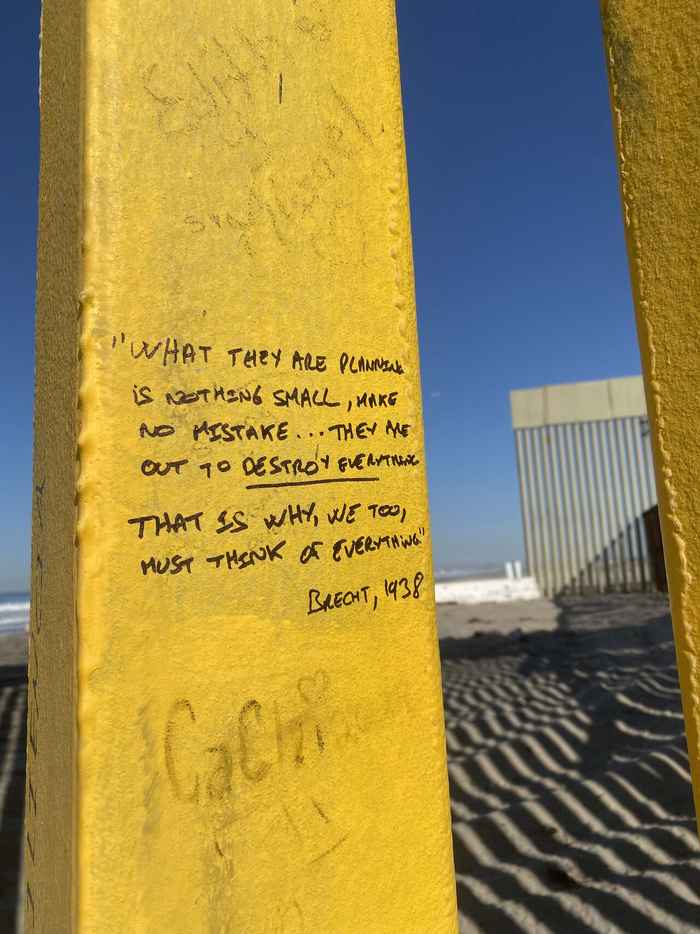
On the final day of the workshop, participants returned to the Wall-a powerful space where violence and hope intersect- to reflect on the insights gained throughout the week. Discussions focused on how scholars, journalists, creatives, and activists can contribute meaningfully to ongoing work on border narratives.
We thank and congratulate our partner institutions and the organisers on the success of the Academy, and on providing participants with the opportunity not only to challenge dominant academic and public narratives of mobility and migration, but to do so from the perspectives of those who live, resist, and support individuals and communities along the U.S.–Mexico border.